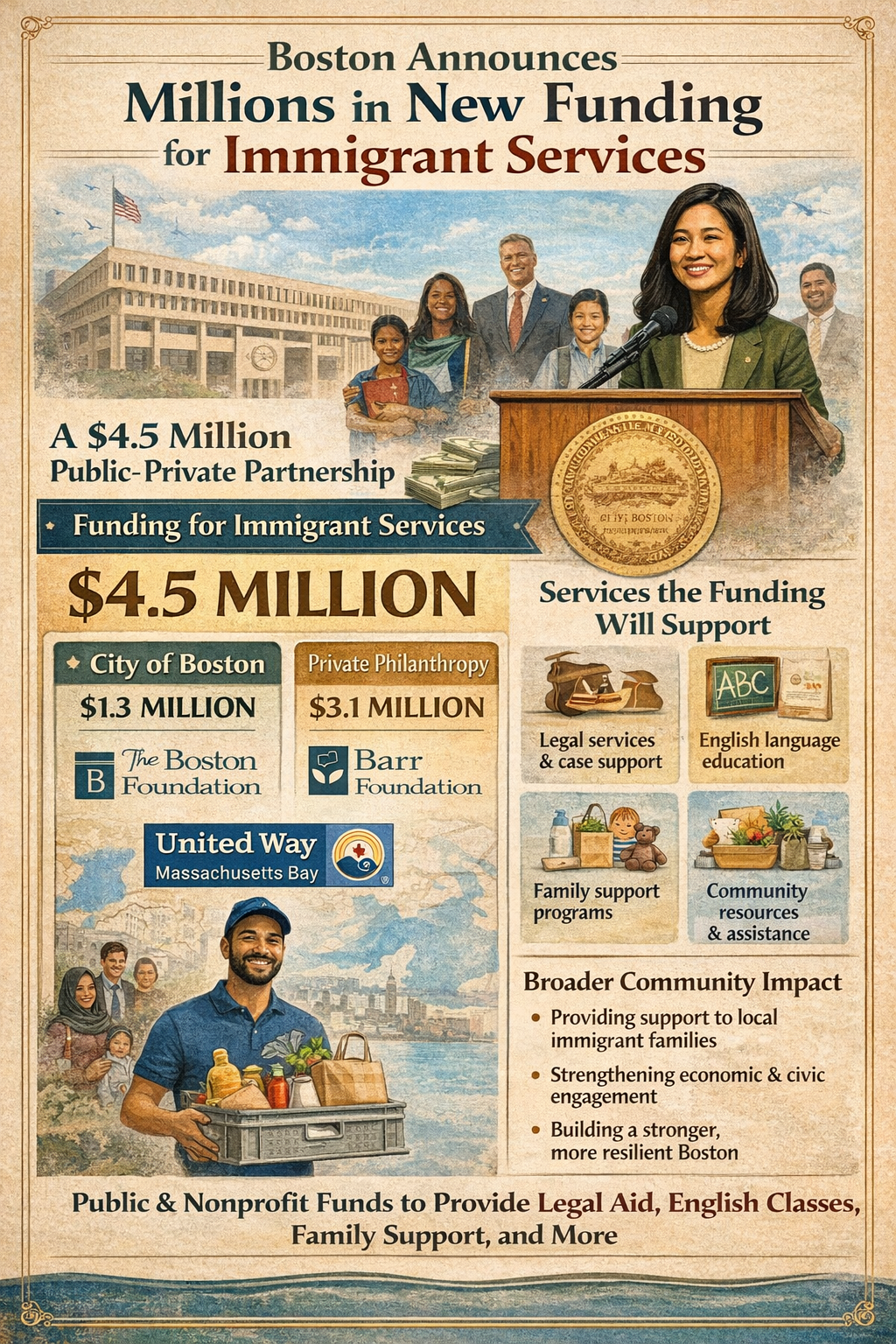
Boston officials have announced a new funding initiative aimed at expanding services for immigrant communities across the city. The plan, unveiled by Michelle Wu, combines public funding and private philanthropy to support programs that provide legal assistance, language education, and basic resources for immigrant families.
A $4.5 Million Public-Private Partnership
The initiative will provide about $4.5 million in funding for immigrant services throughout Boston. The effort is structured as a public-private partnership that combines municipal funding with contributions from major nonprofit organizations.
The City of Boston will contribute more than $1.3 million through the city’s immigrant services programs. In addition, three philanthropic organizations—the The Boston Foundation, Barr Foundation, and United Way of Massachusetts Bay—have committed over $3.1 million to the initiative.
City leaders said the funding is intended to strengthen support networks for immigrant families at a time when many communities face uncertainty regarding federal immigration policies.
Services the Funding Will Support
The new funding will be distributed to nonprofit organizations and community programs that assist immigrants in several key areas. These include:
- Legal services to help immigrants navigate complex immigration cases
- English language education and other learning programs
- Family support programs, including access to basic necessities
- Community resources such as groceries, childcare supplies, and emergency assistance
Officials say the goal is to ensure immigrant families have access to essential services that help them participate fully in the city’s economy and civic life.
A Response to National Immigration Debates
During the announcement, several officials referenced ongoing national debates about immigration policy and enforcement. City leaders framed the initiative as part of Boston’s effort to maintain its identity as a welcoming city for newcomers.
Boston has long supported programs designed to help immigrants integrate into local communities. The city’s Boston Mayor’s Office for Immigrant Advancement works with community organizations to provide resources, information, and services that promote economic and civic participation.
Broader Impact on the Community
Supporters of the funding initiative argue that helping immigrant communities strengthens the broader local economy. Many immigrants contribute to Boston’s workforce, start businesses, and play an active role in neighborhoods throughout the city.
By investing in services such as legal aid, education, and family support, city leaders hope to reduce barriers that immigrants face while building stronger and more resilient communities.
Conclusion
Boston’s new immigrant services funding initiative represents a collaboration between city government and philanthropic organizations to address the needs of immigrant families. With $4.5 million in combined funding, the program aims to expand legal assistance, education programs, and social support services across the city.
As immigration continues to be a major national issue, the initiative reflects Boston’s local strategy of investing in community-based solutions to help immigrant residents succeed.