Introduction
Islam is one of the world’s largest religions, with more than 1.9 billion followers. Muslims share the same core beliefs: faith in one God (Allah), belief in the Prophet Muhammad as the final prophet, the Quran as the holy book, and the Five Pillars of Islam. However, within Islam there are two major branches: Sunni Islam and Shia Islam.
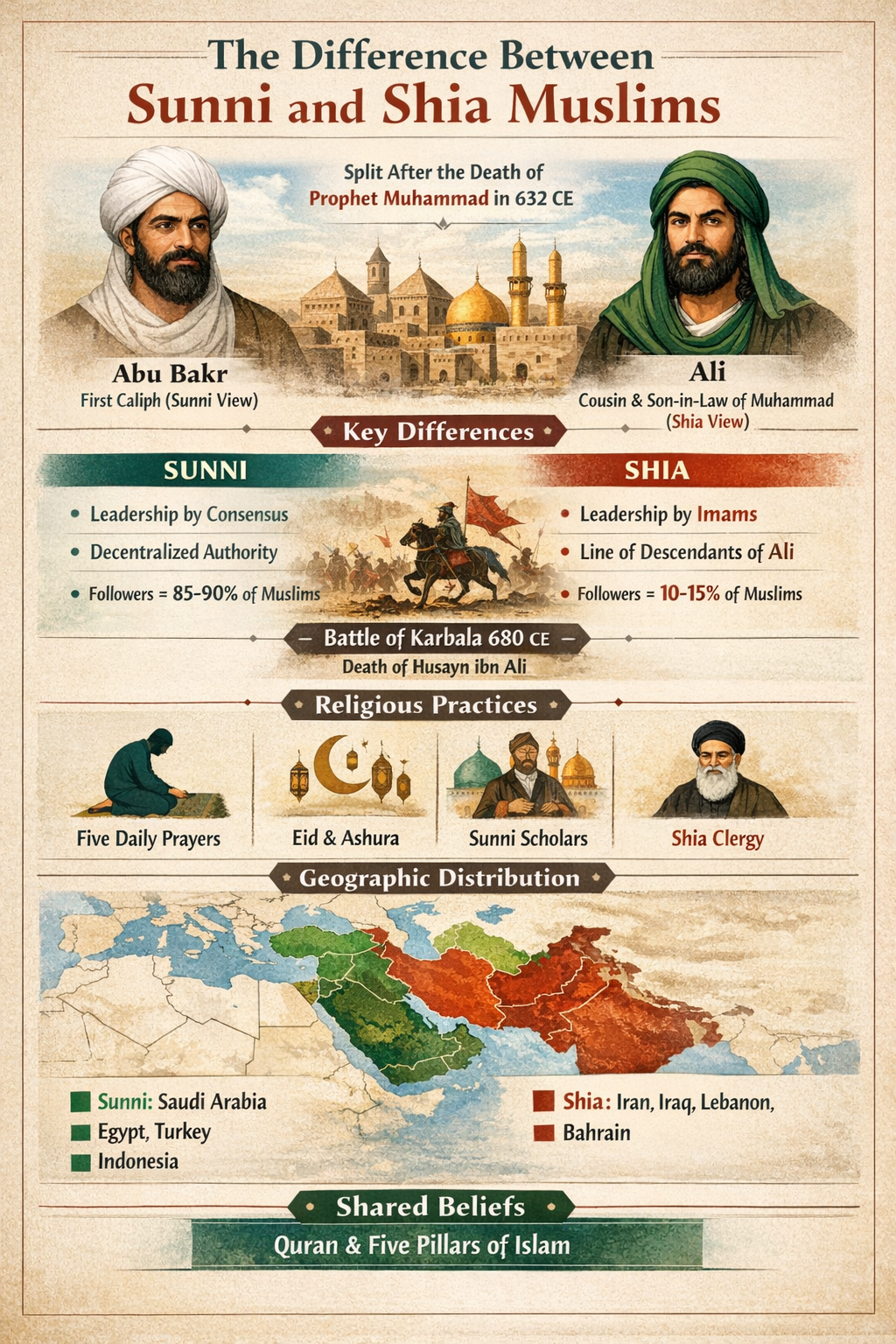
The division between these two groups dates back to a political and religious dispute that arose shortly after the death of Muhammad in 632 CE.
Historical Origins of the Split
After Muhammad died, the Muslim community disagreed about who should lead the Islamic world.
Sunni View
Followers who became known as Sunnis believed the leader (called a caliph) should be chosen by consensus among the community. They supported the selection of Abu Bakr, a close companion of Muhammad, as the first caliph.
Shia View
Those who became known as Shia believed leadership should remain within the Prophet’s family. They believed the rightful successor was Ali, Muhammad’s cousin and son-in-law.
This disagreement over leadership eventually developed into lasting religious, political, and cultural differences.
Leadership and Religious Authority
Sunni Islam
- Sunnis believe leadership of the Muslim community should be based on consensus and qualification.
- Religious authority is decentralized.
- Scholars and legal schools interpret Islamic law.
Shia Islam
- Shia Muslims believe leadership should come from a line of divinely guided leaders called Imams, beginning with Ali.
- Imams are viewed as having special spiritual authority and insight.
One important historical moment reinforcing the divide was the Battle of Karbala in 680 CE, where Husayn ibn Ali (a central figure for Shia Muslims) was killed. This event became a powerful symbol of martyrdom and injustice in Shia tradition.
Religious Practices and Traditions
While Sunnis and Shia share most religious practices, there are some differences:
Prayer
- Both pray five times a day.
- Shia Muslims often combine some prayers, reducing them to three prayer times.
Religious Holidays
- Sunnis and Shia celebrate major Islamic holidays such as Eid al-Fitr and Eid al-Adha.
- Shia Muslims also observe Ashura, commemorating Husayn’s death at Karbala with mourning rituals.
Clergy Structure
- Sunni Islam generally lacks a formal hierarchy.
- Shia Islam has a more structured clergy, including religious scholars known as Ayatollahs.
Geographic Distribution
Today, Sunnis make up about 85–90% of Muslims worldwide, while Shia Muslims represent about 10–15%.
Countries with significant Shia populations include:
- Iran (majority Shia)
- Iraq
- Azerbaijan
- Bahrain
Sunni Muslims form the majority in many countries, including:
- Saudi Arabia
- Egypt
- Turkey
- Indonesia
Political and Modern Implications
Although the Sunni–Shia divide began as a leadership dispute, it has sometimes influenced modern political conflicts in the Middle East. For example, rivalry between Shia-majority Iran and Sunni-majority Saudi Arabia has shaped regional geopolitics.
However, it is important to note that many conflicts in the region are driven by politics, economics, and power struggles rather than purely religious differences.
Conclusion
The difference between Sunni and Shia Muslims originated from a disagreement over who should succeed the Prophet Muhammad. Over time, this disagreement evolved into distinct traditions regarding leadership, religious authority, and certain rituals. Despite these differences, both groups share the core beliefs and practices of Islam and remain united in their fundamental faith.