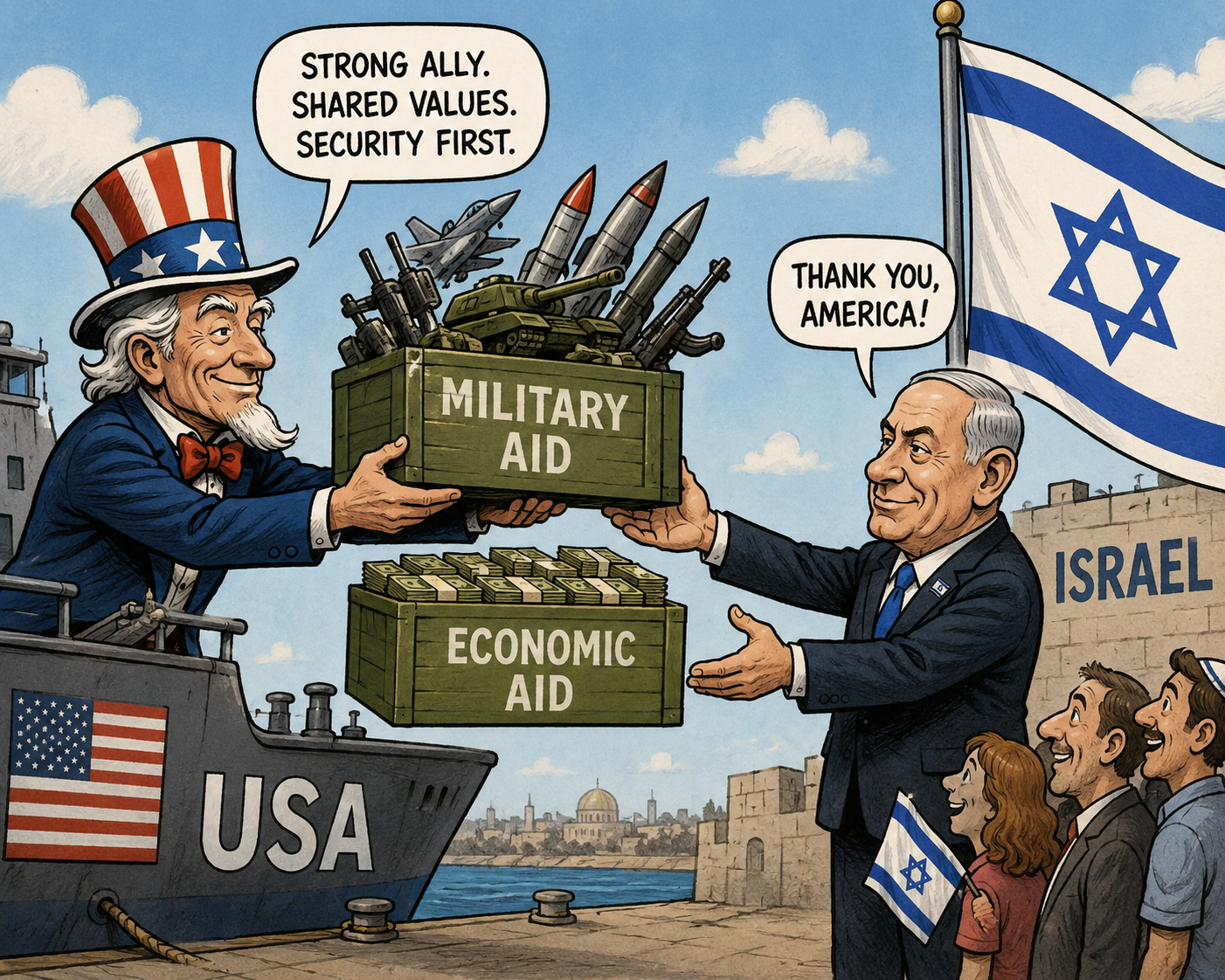
Aid to Israel costs only $11.17 per American, Get over it!
The scale of U.S. military aid to Israel has once again become a major political issue in the United States, as lawmakers, analysts, and voters debate the financial cost, strategic value, and long-term implications of continued support in the Middle East.
Under the current 10-year Memorandum of Understanding signed in 2016, the United States provides Israel with approximately $3.8 billion annually in military assistance. The agreement runs through 2028 and includes $3.3 billion in Foreign Military Financing and roughly $500 million for joint missile defense programs such as Iron Dome, David’s Sling, and Arrow systems.
According to the Congressional Research Service, total U.S. aid obligations to Israel from 1946 through 2025 reached nearly $175 billion in non-inflation-adjusted dollars, making Israel the largest cumulative recipient of U.S. foreign assistance since World War II.
Since the October 7, 2023 Hamas attacks and the subsequent war in Gaza, U.S. military support accelerated significantly. The Council on Foreign Relations reports that Washington approved at least $16.3 billion in direct military aid tied to the conflict, including emergency supplemental packages and increased missile defense funding.
Supporters of the aid argue that Israel serves as one of America’s closest strategic allies in the Middle East. U.S. officials have long cited intelligence sharing, counterterrorism cooperation, missile defense research, and regional military positioning as reasons for maintaining strong defense ties. The U.S. and Israel also jointly develop several advanced defense systems, with much of the funding ultimately flowing back into American defense contractors and manufacturing jobs.
Critics, however, question whether the scale of assistance remains justified amid rising U.S. debt, domestic economic concerns, and growing political divisions over the Gaza conflict. Opponents of the aid packages have argued that American taxpayers should not continue funding large foreign military commitments while infrastructure, healthcare, and economic issues remain unresolved at home.
The debate has also intensified due to regional tensions involving Iran and the Islamic Revolutionary Guard Corps (IRGC). The United States officially designated the IRGC as a Foreign Terrorist Organization in 2019, citing its support for armed proxy groups across the Middle East, including Hezbollah and Hamas. U.S. officials have linked the IRGC to attacks on American personnel and regional destabilization efforts over several decades.
At the same time, Israel has argued that continued military support is essential because of threats from Hamas, Hezbollah, Iranian missile programs, and drone attacks throughout the region.
The political divide inside the United States appears to be widening. Some lawmakers are calling for tighter oversight or conditions on aid, while others continue pushing for expanded security cooperation. Analysts expect the debate to intensify further as negotiations approach for a potential successor agreement to the current U.S.-Israel military aid deal, which expires in 2028.
CHARTS