Cuba Facing Its Worst Economic Crisis in Decades
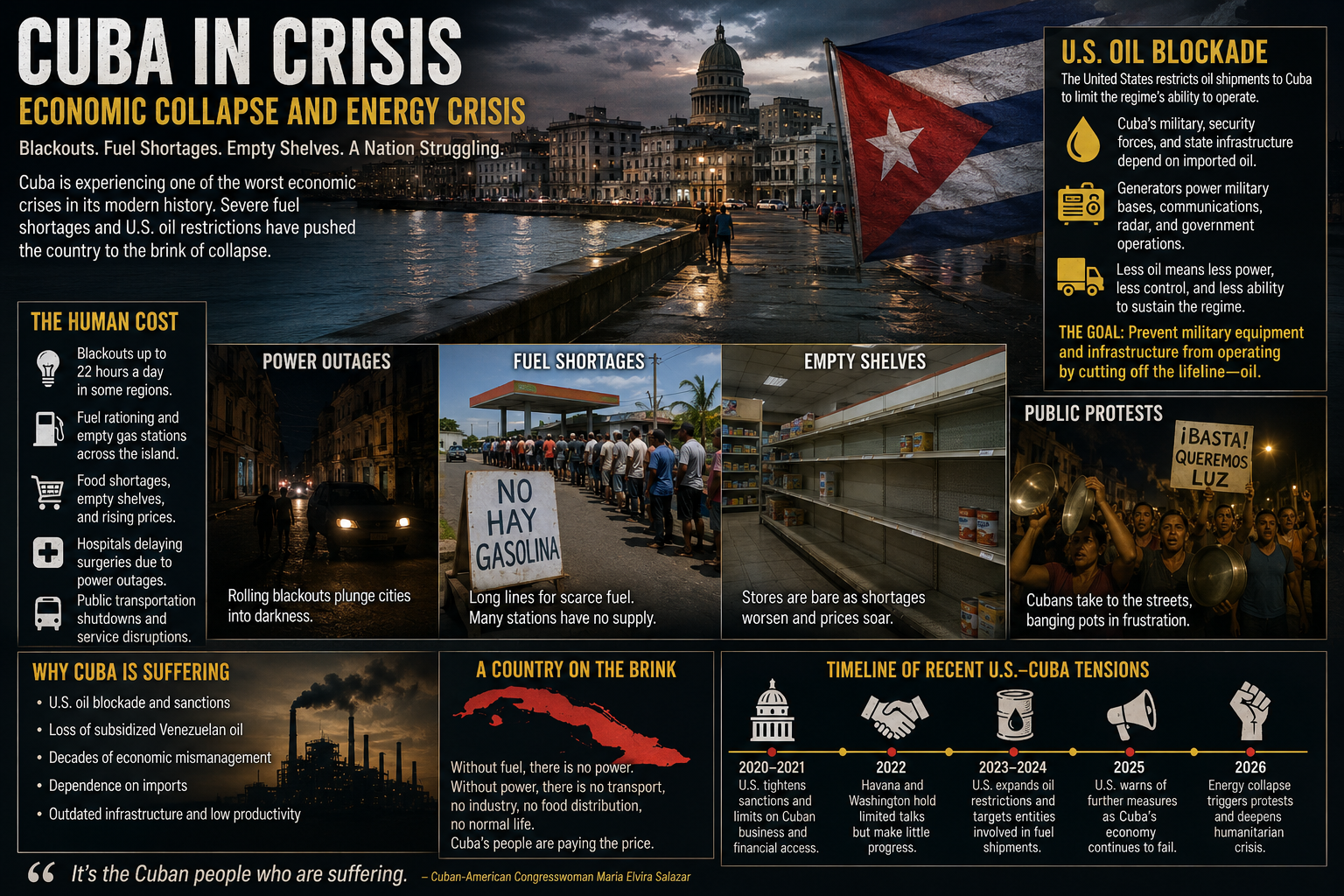
Cuba is experiencing one of the most severe economic and humanitarian crises in its modern history. The country has been hit by rolling blackouts, fuel shortages, food scarcity, transportation shutdowns, inflation, and growing public unrest.
Recent reporting from PBS NewsHour and other international outlets describes a country struggling to maintain basic services as fuel imports collapse and the electrical grid repeatedly fails.
The crisis has become so severe that:
- Hospitals have reportedly delayed surgeries.
- Public transportation systems in Havana have partially collapsed.
- Businesses have shortened hours or closed.
- Food spoilage has increased because of constant power outages.
- Water systems and sewage infrastructure have been disrupted.
The U.S. Oil Blockade and Why It Exists
The current crisis intensified after the United States sharply tightened restrictions on oil shipments reaching Cuba. The measures were designed to pressure the Cuban government and reduce the regime’s ability to sustain military and security infrastructure.
According to multiple reports, the U.S. policy seeks to restrict fuel supplies because much of Cuba’s military and state infrastructure relies heavily on:
- diesel-powered generators,
- fuel-based electrical systems,
- military transport networks,
- centralized state-controlled logistics.
Cuba’s government depends heavily on imported oil to power:
- the national electrical grid,
- military installations,
- transportation systems,
- industrial facilities,
- communications infrastructure.
Analysts note that reducing oil access places enormous pressure on both civilian systems and the Cuban state apparatus. Critics argue the policy has severely impacted ordinary Cuban citizens, while supporters say the restrictions are intended to weaken the government’s ability to maintain authoritarian control.
Nationwide Blackouts and Fuel Collapse


6
Cuba’s energy minister recently stated that the country had effectively run out of diesel and fuel oil reserves.
The consequences have been dramatic:
- Blackouts lasting up to 22 hours in some regions.
- Gasoline shortages across the island.
- Fuel rationing programs.
- Major disruptions to agriculture and food distribution.
- Reduced air travel and shipping activity.
Reuters reported that Cuba nearly doubled gasoline and diesel prices while many filling stations remained closed due to lack of supply. Black market fuel prices reportedly surged far beyond what average citizens can afford.
The collapse of Venezuelan oil support has further worsened the situation. For years, Cuba depended heavily on subsidized Venezuelan crude shipments to maintain its economy and electrical grid.
Daily Life in Cuba
Ordinary Cubans are facing increasing hardship.
Reports from Havana describe:
- long lines for food and fuel,
- empty grocery shelves,
- failing refrigeration systems,
- transportation breakdowns,
- rising crime and public frustration,
- worsening shortages of medicine and medical equipment.
Many families reportedly plan their day around short windows of electricity availability to:
- cook meals,
- charge phones,
- pump water,
- refrigerate food.
Public protests have also increased, with demonstrators banging pots and pans in response to prolonged outages and worsening economic conditions.
Political Tensions Between the U.S. and Cuba
Relations between the United States and Cuba have deteriorated sharply in 2026.
Recent tensions include:
- expanded sanctions,
- restrictions on oil shipments,
- diplomatic confrontations,
- increased U.S. pressure on Cuban leadership,
- debates over possible political transition scenarios.
U.S. officials argue the Cuban government and military-controlled business networks are responsible for much of the country’s economic dysfunction. Cuban officials blame the U.S. embargo and energy blockade for the collapse in living conditions.
Structural Problems Inside Cuba
While the energy blockade has accelerated the crisis, economists note that Cuba has long struggled with:
- low industrial productivity,
- centralized economic planning,
- dependence on imports,
- deteriorating infrastructure,
- limited private enterprise,
- declining foreign investment.
Many analysts believe these structural weaknesses made Cuba especially vulnerable once fuel imports declined.
Overall Assessment
Cuba now faces a combination of:
- severe fuel shortages,
- electrical grid instability,
- inflation,
- transportation collapse,
- declining industrial output,
- and rising public frustration.
The U.S. oil blockade was designed to pressure the Cuban government and restrict the operation of state and military infrastructure dependent on fuel-powered systems. However, the humanitarian effects have spread across nearly every sector of Cuban society.
Without major new fuel supplies, economic reforms, or international assistance, analysts warn the country could face an even deeper humanitarian and political crisis in the months ahead.