As of late February 2026, the question of whether the United States will attack Iran has reached its most critical point in years. The geopolitical landscape is currently defined by a high-stakes “Geneva ultimatum,” massive military movements, and a cycle of brinkmanship that many experts believe is shifting from “if” to “when.”
Here is an overview of the current situation and the factors driving the potential for conflict.
1. The Military “Armada”: A Show of Force
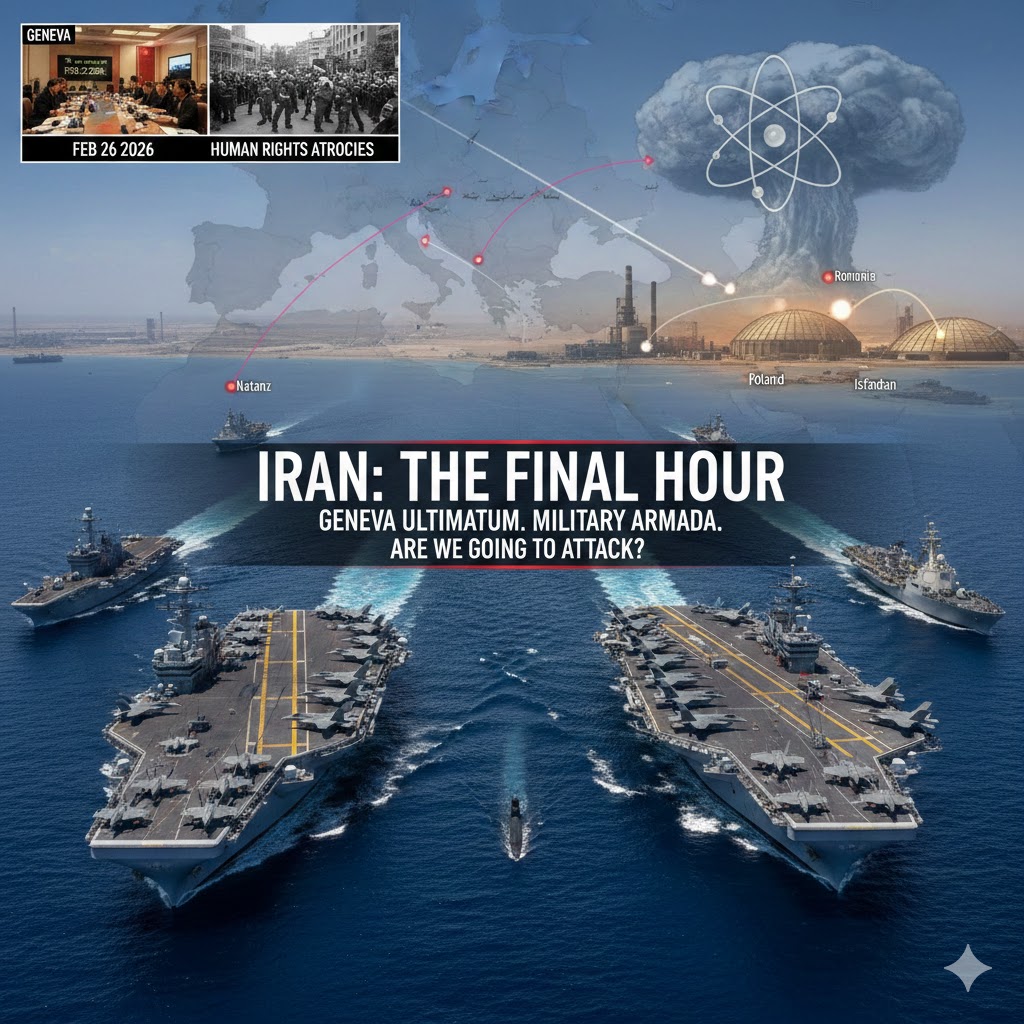
The U.S. has assembled its largest concentration of naval and air power in the Middle East since the 2003 Iraq War.
- Carrier Groups: The USS Abraham Lincoln and the USS Gerald R. Ford are currently in position. These carriers, along with their strike groups, provide the Pentagon with the capability for a sustained, multi-week air campaign.
- Strategic Positioning: To minimize risk from Iranian missile counter-strikes, the U.S. has moved over 150 aircraft to bases in Eastern Europe and the Middle East, ensuring they can operate just out of range of Iran’s primary defensive reach.
- The Timeline: While some officials suggested strikes could have occurred as early as last weekend, the arrival of the full “armada” by mid-March 2026 is seen by many analysts as the final window of preparation.
2. The Nuclear Red Line: “Operation Midnight Hammer”
Tensions are fueled by the fallout of “Operation Midnight Hammer,” the precision U.S. strikes in June 2025 that targeted Iranian nuclear facilities.
- The Dispute: President Trump recently claimed the U.S. “obliterated” Iran’s nuclear capabilities. However, the IAEA and satellite intelligence from early 2026 suggest Iran is aggressively rebuilding.+1
- Reconstruction: Satellite imagery of sites in Natanz and Isfahan shows new roofing and underground “sealing” operations, which the U.S. views as an attempt to shield a restarted weapons program from future attacks.
- Zero Enrichment: The U.S. has maintained a “zero enrichment” demand. Iran’s refusal to stop all uranium enrichment remains the primary diplomatic “poison pill.”
3. Internal Turmoil and Human Rights
The current administration has increasingly linked military action to Iran’s domestic situation.
- Protest Crackdowns: Following nationwide protests in December 2025 and January 2026, reports indicate a brutal crackdown by the Iranian regime. The U.S. has used these “human rights atrocities” as a moral justification for increased military pressure.
- Regime Stability: There is a growing sense in Washington that the Iranian theocracy is at its most vulnerable point in decades due to 60% inflation and domestic unrest, leading some hawks to argue that a strike could catalyze “regime change.”
Are we going to attack?
The honest answer is that the U.S. is currently in a state of maximum readiness, but a final decision appears tied to the success or failure of the Geneva talks scheduled for Thursday, February 26, 2026.
| Potential Outcome | Likelihood | Driver |
| Limited Strike | High | If Geneva talks fail and Iran continues rebuilding nuclear sites. |
| Interim Deal | Moderate | If Iran offers significant concessions, like shipping out enriched uranium. |
| Full-Scale War | Low | Neither side currently appears to want a ground invasion, preferring air/sea strikes. |
Bottom Line: We aren’t just “waiting” anymore; we are in the “final hour” of diplomacy. The U.S. has set a de facto deadline for the end of February. If the Geneva negotiations do not produce a breakthrough, the military assets currently in the Persian Gulf are fully prepared to transition from “deterrence” to “active engagement.”