Date: March 25, 2026
Location: Camp Victory (Victory Base Complex), Baghdad, Iraq
Subject: First-person view (FPV) drone attack on U.S. military rotary-wing assets and air defense infrastructure.
Executive Summary
On March 24, 2026, footage surfaced showing a coordinated FPV drone attack by an Iranian-backed militia against the U.S. military’s Camp Victory near Baghdad International Airport. The strike successfully targeted a parked UH-60 Black Hawk helicopter and a radar component of the NASAMS air defense system. This incident marks a significant escalation in the technical capabilities of regional militias, demonstrating the use of low-cost, high-precision loitering munitions against hardened U.S. installations.
Details of the Incident
According to video evidence and analysis by Defence Blog, a small, maneuverable FPV drone—likely a modified commercial or semi-custom platform equipped with an explosive payload—penetrated the perimeter of Camp Victory.
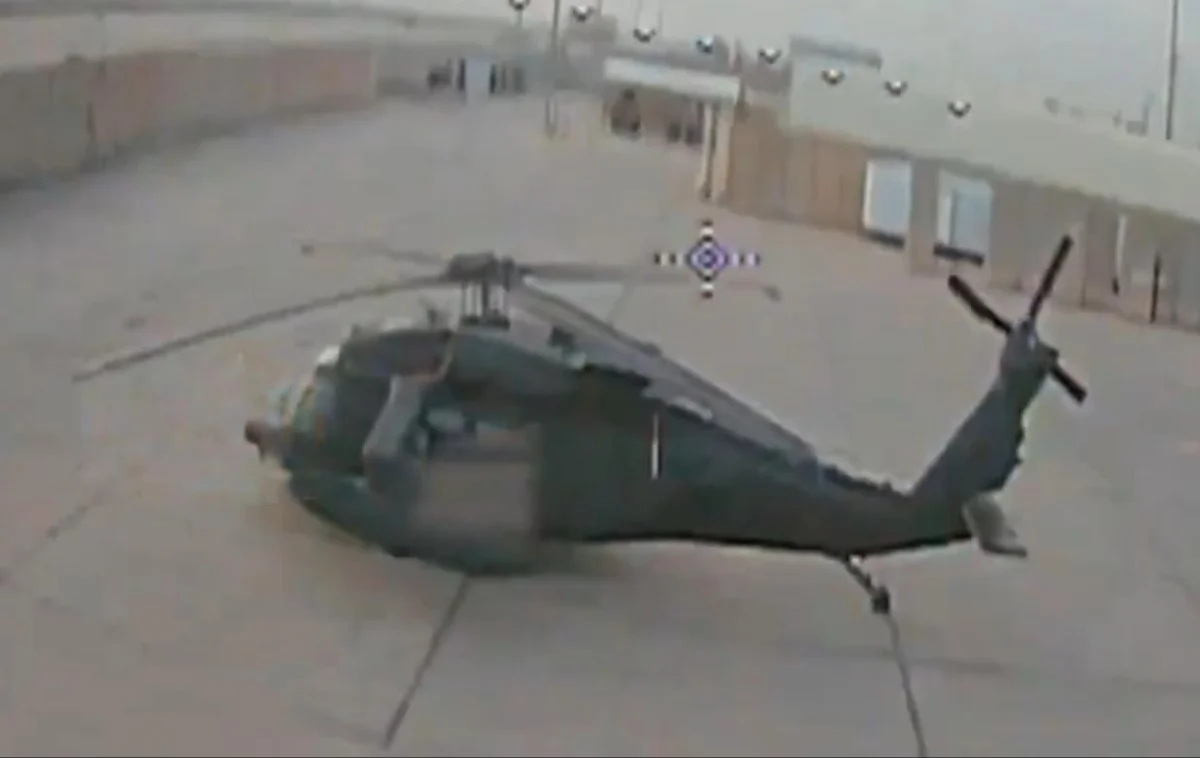
- The Target: The drone achieved a direct hit on a Black Hawk helicopter stationed on a landing pad.
- The Variant: While the U.S. military has not confirmed the specific damage, OSINT analysts (including Evergreen Intel) noted that the militia blurred portions of the video, likely to obscure a red cross symbol. This suggests the target was an HH-60M, a medical evacuation (MEDEVAC) variant of the Black Hawk.
- Additional Strikes: Separate footage released from the same operation showed a drone hitting an AN/MPQ-64 Sentinel radar, which is a critical sensor for the NASAMS (National Advanced Surface-to-Air Missile System). Post-strike imagery showed the radar unit on fire.
Technical Observations
- Fiber-Optic Guidance: Some analysts suggest the drones used in this wave of attacks may employ fiber-optic guidance. This technology allows the drone to fly at low altitudes without signal disruption from electronic warfare (jamming) and eliminates the radio signature usually used for detection.
- Air Defense Penetration: The drones appeared to fly over the base for nearly two minutes, conducting “live reconnaissance” before selecting a target. There was no visible attempt at interception by C-RAM (Counter Rocket, Artillery, and Mortar) or other automated defense systems.
- Cost Asymmetry: The attack highlights a growing vulnerability where drones costing a few hundred to a few thousand dollars can disable multi-million dollar assets like the UH-60M or Sentinel radar.
Strategic Implications
This strike is part of a broader trend of “drone swarming” and precision loitering attacks by pro-Iranian groups in Iraq.
- Target Selection: By targeting MEDEVAC helicopters and air defense radars, the militias are moving beyond “nuisance” attacks (which typically hit open ground or hangars) to surgical strikes on high-value, specialized equipment.
- Defensive Gaps: The success of the strike raises questions about the effectiveness of current U.S. short-range air defense (SHORAD) against small, low-flying FPV drones that do not follow the predictable ballistic paths of rockets or mortars.
Conclusion
The FPV strike at Camp Victory represents a “new precedent” for militia warfare in the Middle East. As these groups refine their use of FPV and fiber-optic technology, U.S. forces face an evolving threat that requires rapid investment in specialized counter-UAS (Unmanned Aircraft Systems) technology to protect stationary assets.
*** Source: Compiled from Defence Blog, United24 Media, and OSINT Analysis (March 2026).