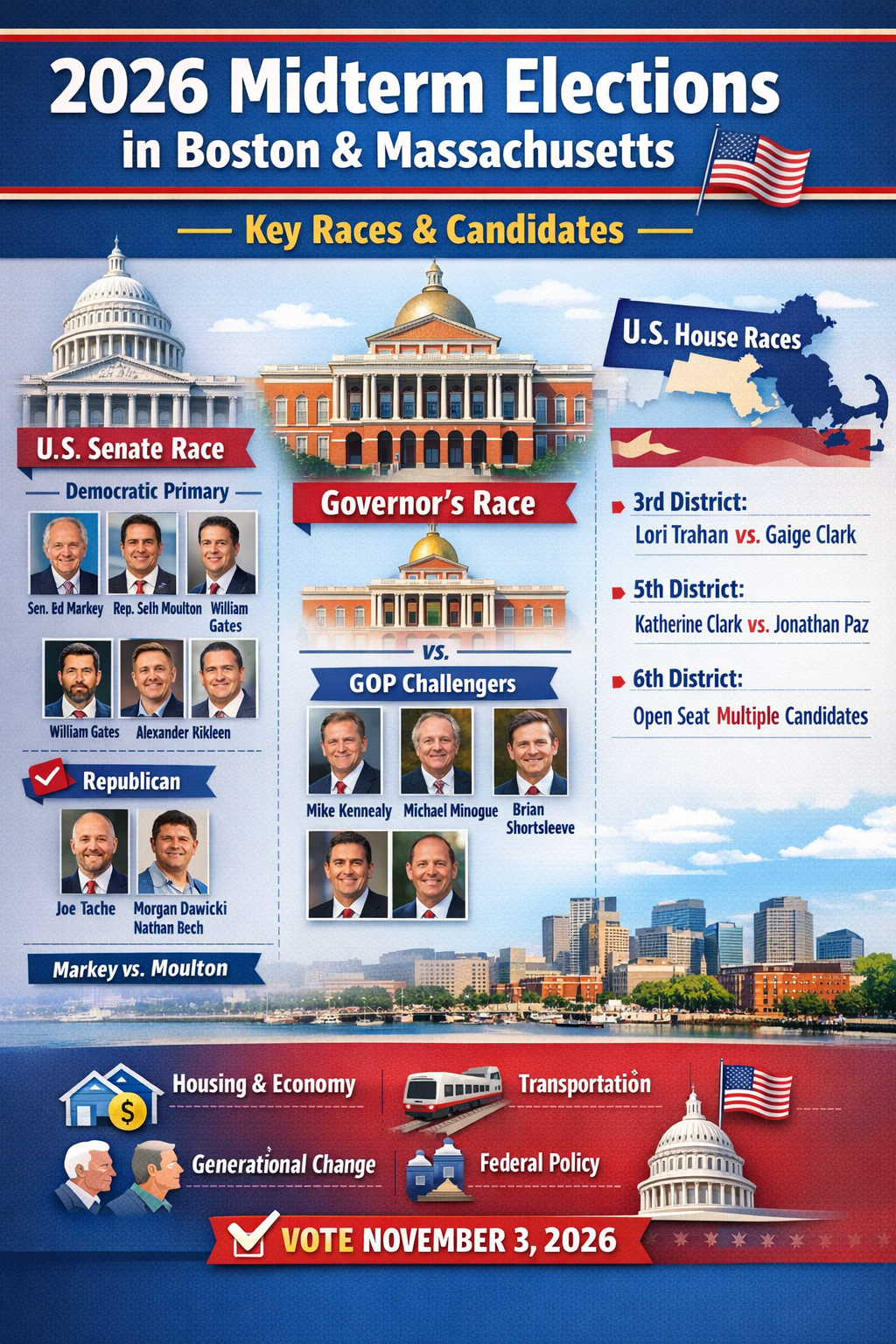
The 2026 midterm elections in Massachusetts will take place on November 3, 2026, with primaries scheduled for September 1, 2026. Voters will elect a governor, members of Congress, the entire state House, part of the state Senate, and several statewide offices.
Local Boston politics plays a major role in these elections because many competitive races involve Boston-area districts and state-level seats influenced by Boston voters.
1. Massachusetts Governor Race (Statewide but heavily influenced by Boston voters)
The biggest race in Massachusetts in 2026 is the governor’s race.
Major candidates so far:
- Maura Healey (Democrat) – the incumbent governor running for reelection.
- Kim Driscoll (Democrat) – running again for lieutenant governor alongside Healey.
- Andrea James (Independent) – criminal-justice activist running an independent campaign.
- Republican candidates are still forming a field, but the race is expected to become more competitive as the election approaches.
According to local coverage, the 2026 race is expected to focus heavily on:
- housing affordability in Boston
- taxes and business climate
- crime and public safety
- public transportation (MBTA issues)
2. U.S. House of Representatives Candidates (Boston-Area Districts)
Boston is represented primarily by two congressional districts, and both are on the ballot in 2026.
District 7 (Boston, Roxbury, Dorchester, etc.)
- Ayanna Pressley (Democrat – incumbent) is running for reelection.
This is considered a very safe Democratic seat, but progressive vs. establishment politics could still influence the primary.
District 8 (South Boston, parts of Boston suburbs)
- Stephen Lynch (Democrat – incumbent) is running again.
- Patrick Roath (Democrat) is listed as a challenger.
Other Massachusetts congressional races affecting Boston-area voters
- Jake Auchincloss (District 4) is running again and has primary challengers.
- The District 6 race is becoming competitive because the incumbent is leaving to run for the Senate, leading to a crowded Democratic primary.
3. Massachusetts State Senate Candidates (Including Boston Districts)
Several important State Senate races involve Boston directly.
1st Suffolk District (South Boston)
- Nick Collins (Democrat – incumbent) is running again.
- Latoya Gayle (community activist) is challenging him in the Democratic primary.
This race is important because Collins has had public conflicts with Boston city leadership, which could influence the outcome.
Suffolk & Middlesex District
- William Brownsberger (Democrat – incumbent) is running again.
- Daniel Lander (a senior aide to Boston Mayor Michelle Wu) is running against him.
This could become one of the most important ideological primary races in the Boston area.
4. Massachusetts House of Representatives (All 160 Seats Up in 2026)
Every seat in the Massachusetts House will be on the ballot in 2026.
While most districts are considered safe Democratic seats, the following types of races will matter the most in Boston:
- Open seats created by retirements
- Progressive vs. moderate Democratic primaries
- Local housing-policy and zoning debates influencing campaigns
Democrats currently hold a large majority (more than 130 seats), but the real political competition in Boston is usually within the Democratic Party rather than between parties.
5. Secretary of the Commonwealth (Massachusetts Secretary of State) Race
Another statewide race that will impact Boston voters is the Secretary of State election.
Candidates so far:
- William F. Galvin (Democrat – incumbent) is running for a ninth term.
- Becca Rausch (state senator) is mentioned as a possible challenger.
This race will likely focus on:
- election laws
- voting access
- mail-in ballots
- election security
6. Key Political Trends in Boston for the 2026 Midterms
Based on early coverage of the 2026 midterms, the biggest themes in Boston-area races are expected to be:
1. Housing and cost of living
This is likely to be the biggest issue in both state and federal races.
2. Progressive vs. moderate Democrats
Many of the most competitive races (especially state Senate races) will be Democratic primary battles rather than Republican vs. Democrat contests.
3. Public safety and immigration policy debates
These issues are becoming more prominent in Massachusetts politics than in previous election cycles.
4. Open-seat races
Whenever an incumbent retires (especially in state Senate districts), large candidate fields tend to form and make the race competitive.
7. Summary
The 2026 midterm elections in Boston and Massachusetts will not be dominated by one single race but instead by several key contests:
- The governor’s race (Healey running for reelection)
- Boston-area U.S. House races (Pressley and Lynch seats)
- Competitive State Senate primaries in Suffolk County
- All 160 Massachusetts House seats
- The Secretary of State election
As the primary election gets closer (summer 2026), many more candidates—especially at the state-representative level—are expected to officially enter the race.