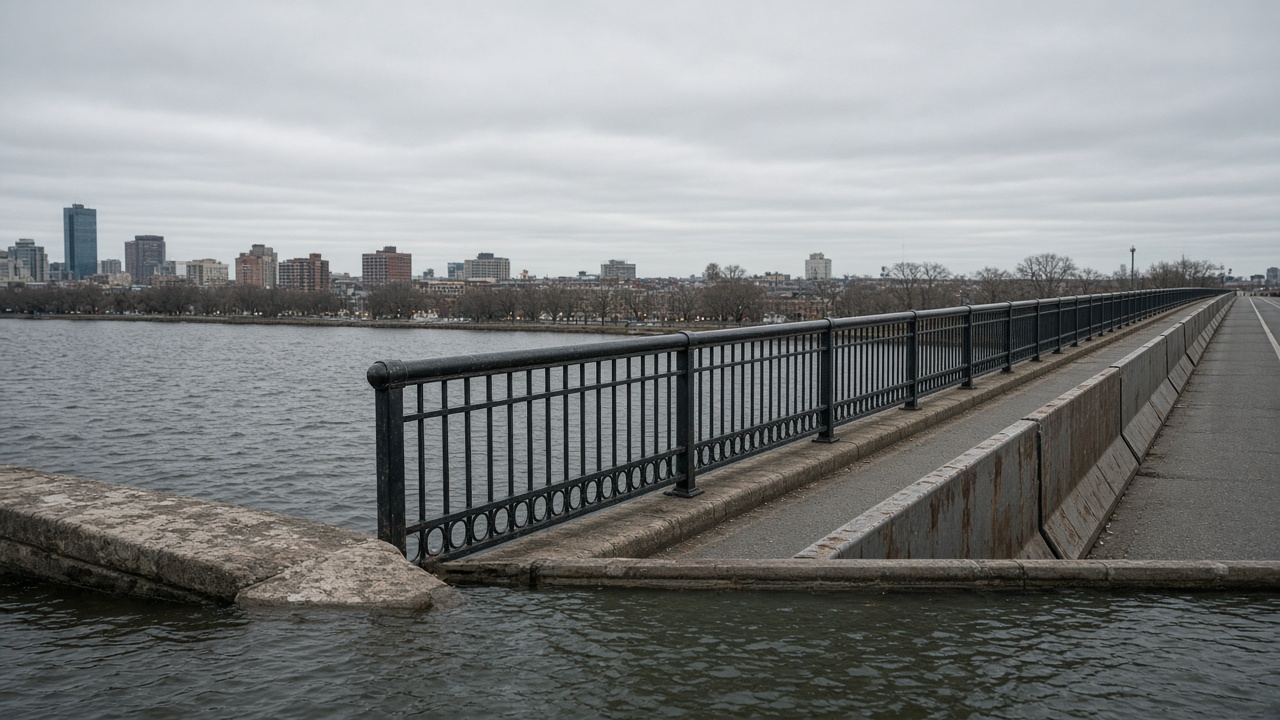
A River Street Bridge Boston hit-and-run Tuesday afternoon knocked a six-foot section of bridge wall into the Charles River, briefly disrupting a key Boston–Cambridge crossing before temporary repairs reopened normal traffic flow.
Massachusetts State Police said the crash occurred around 12:50 p.m. on Cambridge Street at the bridge’s Boston side near Soldiers Field Road. Preliminary accounts describe a sideswipe involving two vehicles: one driver fled, and the other vehicle was forced onto the sidewalk into the bridge wall. A roughly six-foot chunk of wall fell into the river. No injuries were immediately reported, according to Boston.com, the Boston Globe, and NBC Boston.
What investigators say happened
State Police collected witness statements and said the investigation is ongoing. An SUV remained on the sidewalk near the damaged wall and was later towed. NBC Boston spoke with a man at the scene who identified himself as the SUV driver and said he had been sideswiped by a pickup after coming off a Massachusetts Turnpike exit ramp, sending his vehicle into the wall. He said he was surprised but did not feel he was going into the river.
That account aligns with the sideswipe narrative in police summaries but does not by itself identify the fleeing vehicle. No arrests were announced in initial coverage.
MassDOT’s temporary fix and safety finding
The Massachusetts Department of Transportation installed a temporary steel barrier where the wall failed and placed an arrow board in the left lane to keep traffic away from the damaged edge. Police said the bridge was determined safe for traffic and the scene was clear before 2 p.m. A fuller inspection is scheduled to define permanent repairs.
For a span linking Boston and Cambridge near major parkways, a midday closure—even a short one—ripples into Soldiers Field Road, Memorial Drive approaches, and nearby neighborhoods. The quick barrier install limited that disruption, but the missing wall section is a reminder that vehicle impacts can become infrastructure incidents within seconds.
Why Charles River crossings get extra scrutiny
Boston’s river bridges carry commuters, cyclists, and emergency vehicles between employment centers and residential districts. Barrier walls are both safety hardware and structural edges; when a section drops into the Charles, agencies must confirm that the roadway deck and remaining parapet remain sound. Declaring the bridge “safe for traffic” with a temporary steel barrier is an interim engineering judgment, not the final repair.
Pedestrians and cyclists who use sidewalk-adjacent space on such bridges also face changed geometry when barriers and arrow boards shift lanes. Drivers should expect narrowed left-side clearance until permanent wall work is complete.
Hit-and-run enforcement and what’s next
Hit-and-run cases often turn on witness descriptions, nearby cameras, and vehicle damage consistent with a sideswipe. State Police have not publicly detailed camera leads in this case. Residents with dashcam or doorbell footage from the 12:50 p.m. window Tuesday may still be relevant to investigators.
Until repairs finish, the verified local facts are clear: a River Street Bridge crash sent bridge fabric into the Charles; nobody was reported hurt; a fleeing vehicle remains part of the probe; and MassDOT’s temporary barrier is what Boston–Cambridge drivers will see for now. In a week already crowded with transit outages and storm prep, even a two-hour bridge scare adds to the sense that Greater Boston’s infrastructure is absorbing daily stress from traffic violence as well as weather and age.
Drivers who regularly use the River Street crossing should watch for temporary lane guidance and give wider berth to the steel barrier until permanent parapet repairs are finished. Cambridge and Boston traffic feeds into the same choke points when any Charles River span loses a lane or draws rubbernecking, so even a cleared scene can produce residual congestion into the evening commute.
Local officials have not announced a public timeline for permanent wall reconstruction in initial reports. Until MassDOT completes inspection findings, the temporary installation is the operational answer: keep the bridge open, protect the damaged edge, and continue the hit-and-run investigation separately from the engineering work.